Let me tell you something that might blow your mind the next time you reach for your morning pour-over.
Back in the 17th and 18th centuries, the Western world was waking up — not just literally, but intellectually. Some of the most consequential political philosophy in human history was taking shape. Manifestos were being drafted. Paradigms were shifting. And the quiet catalyst running through the veins of the great minds doing this work was not wine, not ale, not spirits — it was coffee.
A humble little bean, native to the highlands of Ethiopia, carried across oceans by ancient trade routes, transformed into a hot, dark drink that sharpened minds instead of dulling them. And in doing so, it helped change the course of civilization.
The Penny University
Across Europe — England especially — the coffee house arrived like a quiet revolution. These were not fancy cafes with overpriced lattes and laptop warriors. They were called “Penny Universities.” Drop one penny — about the price of a single cup — and suddenly you had entry to a living, breathing academy. No tuition. No lectures. No gatekeepers. Just a seat, a brew, and whoever happened to be in the room that day: merchants, writers, scientists, politicians, dreamers.
Think about that for a moment. In an era defined by rigid class hierarchy, where your birth determined your station and your station determined your voice, these rooms were radically egalitarian. A dockworker could sit next to a duke. A pamphleteer could challenge a parliamentarian. The only price of admission was a penny and a willingness to engage.
From Buzzed to Buzzing with Ideas
For centuries, alcohol had ruled the social gathering places of Europe. People met in taverns, sure, but the conversations were often slurred, sentimental, or straight-up belligerent. Ale was the default social lubricant, and it showed. The entire continent was, to put it charitably, a little foggy.
Coffee changed the game.
It sobered the mind rather than clouding it. Clarity replaced haze. Focus replaced stupor. Suddenly people were not just talking — they were thinking, arguing, challenging each other, and building on ideas day after day. That subtle shift — from “buzzed” to “buzzing with ideas” — was one of the most profound and underappreciated transitions in intellectual history.
Ideas began flowing freely in these rooms: reason over superstition, science over dogma, individual rights over the divine right of kings. The conversations that unfolded over steaming cups were not idle chatter. They were the raw material of the British and French Enlightenment itself — the philosophical foundation for the American experiment and system of governance.
Where the Modern World Was Brewed
The roster of London coffee house regulars reads like a who’s who of Western civilization. Isaac Newton dropped by to talk physics. Samuel Pepys chronicled the age from his favorite seat. Robert Hooke, Christopher Wren, and Edmund Halley — the men who literally mapped the stars and rebuilt London after the Great Fire — hashed out ideas over steaming cups. Voltaire, who reportedly drank 40 cups a day, sharpened his wit and his pen over the brew. Jonathan Swift, Alexander Pope, and Samuel Johnson were fixtures. Pamphlets and early newspapers were born and distributed right there on those wooden tables. Lloyd’s of London started as a coffee house. The London Stock Exchange grew out of one. The modern insurance industry, the free press, parliamentary debate culture — all of it incubated in rooms that smelled of roasted beans and tobacco smoke.
Locke, the Coffee House, and the Blueprint for Freedom
But there is one name in this crowd that deserves special attention, because his ideas did more to shape the free world than perhaps any other single thinker: John Locke.
Locke was right there in the thick of it — part of that late 17th-century London intellectual scene, frequenting the same coffee houses as Newton and Hooke and Halley. Historical accounts place him explicitly among the notables seen enjoying this new drink in those venues. And this was not casual socializing. The coffee house was the perfect incubator for what Locke was working on: ideas so dangerous they could get a man killed.
His Two Treatises of Government laid out the philosophical architecture that the entire modern free world still rests on. Natural rights — life, liberty, property. The consent of the governed. Limited government. And the radical, electrifying idea that if rulers violated the social contract, the people had not just the right but the duty to overthrow them. These were not abstract musings. They were blueprints for the American revolution, refined in exactly the kind of sober, reasoned debate that coffee houses made possible.
Think about the environment that produced these ideas. Not a royal court. Not a university lecture hall. A room where anyone with a penny could sit down, where the drink sharpened your thinking instead of blurring it, and where you could openly challenge the most powerful ideas of the day without a bishop or a magistrate hovering over your shoulder. The coffee house did not just host Locke’s thinking — it embodied his philosophy. It was a living prototype of the open, egalitarian, consent-based society he was describing on paper.
And here is where the story gets really good. Locke’s influence did not stay in London. It crossed the Atlantic and landed directly in the minds of the men who would found America. Jefferson, Adams, Franklin, Madison — they were not just familiar with Locke. They were steeped in him. When Jefferson wrote “life, liberty, and the pursuit of happiness,” he was paraphrasing Locke’s “life, liberty, and property.” The Declaration of Independence is, in many ways, Locke’s Two Treatises distilled into a battle cry. The idea that government derives its legitimacy from the consent of the governed — that is pure Locke, conceived in the coffee-fueled intellectual ferment of 17th-century London and deployed a century later to launch a nation.
The public sphere — that essential space where modern democracy first learned to breathe — was literally brewed in coffee houses. Jurgen Habermas, the German philosopher, would later write about this exact phenomenon: the emergence of a “bourgeois public sphere” where private citizens came together to discuss matters of public concern, independent of church or crown. He was describing coffee houses. And John Locke was sitting right there in them, writing the operating system for the free world.
Jefferson at Le Procope
If Locke wrote the philosophical source code, Thomas Jefferson compiled it into a working nation — and he did a remarkable amount of that work in a coffee house, too.
While serving as American minister to France from 1785 to 1789, Jefferson became a regular at Café Procope in Paris — the oldest surviving café in the city, opened in 1686, and the legendary epicenter of Enlightenment thought. This was not some tourist curiosity. Le Procope had been the intellectual home of Voltaire, Rousseau, Diderot, and d’Alembert. Benjamin Franklin had been a patron before Jefferson. By the time Jefferson arrived, the place was still humming with philosophes and revolutionaries, and he walked right into the middle of it. Jefferson himself noted dining there “many times, as did all my friends.”
Picture the scene: the man who had already drafted the Declaration of Independence, sitting in a hive of Enlightenment debate in pre-revolutionary Paris, absorbing and contributing to conversations about republicanism, individual rights, and secular governance over cups of coffee. These were not idle evenings. They were late-night sessions that helped refine the American experiment in real time. Jefferson was simultaneously shaping the Virginia Statute for Religious Freedom and advising Lafayette on what would become the French Declaration of the Rights of Man. The ideas flowed in both directions — American revolutionary thought feeding French Enlightenment philosophy and vice versa — and the medium of exchange was conversation, fueled by coffee, in a café.
The through-line is almost too clean: Locke’s ideas, forged in the coffee houses of 17th-century London, absorbed by Jefferson, who then refined them further in the coffee houses of 18th-century Paris, and carried them back across the Atlantic to build the institutions of the world’s first modern republic.
Smith, Hume, and the Invention of Free Markets
Locke gave the free world its political philosophy. Jefferson turned it into a nation. But there was a third revolution brewing simultaneously — an economic one — and it was happening in the coffee houses of Edinburgh and London, powered by the same drink and the same dynamic.
Adam Smith’s world was the Scottish Enlightenment, which was exploding in the mid-18th century with an intensity that rivaled anything happening in London or Paris. And the nerve center of that explosion was places like John’s Coffee House on Edinburgh’s Royal Mile, where Smith and his close friend David Hume — arguably the two most important thinkers Scotland has ever produced — would sit and argue for hours. No alehouse fog. Just caffeine-powered clarity and two of the sharpest minds in history bouncing ideas off each other, turning abstract moral philosophy into something razor-edged and practical.
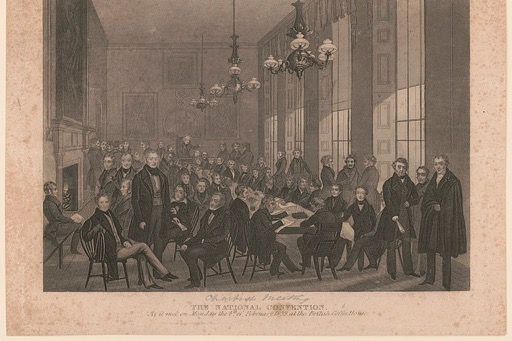
Smith’s masterpiece, The Wealth of Nations, published in 1776 — the same year as the Declaration of Independence, which is not a coincidence so much as a symptom of the same Enlightenment fever — was partly drafted and debated in these coffee houses. Some accounts place him writing much of it at the British Coffee House in London, a favorite haunt for Scots living in the capital. The ideas that emerged from those sessions — free trade, the division of labor, the invisible hand, the radical notion that self-interest, properly channeled, could serve the public good — these were not the products of solitary genius. They were sharpened in conversation, in rooms full of moral philosophers, economists, and literati who challenged each other over steaming cups.
What strikes me about Smith is how perfectly his ideas mirror the environment that produced them. The coffee house was the free market in miniature: open entry, voluntary exchange, no central authority dictating the conversation, and a spontaneous order emerging from the collision of independent minds. Smith was not just theorizing about free markets. He was sitting in one every afternoon.
Between Locke, Jefferson, and Smith, coffee houses incubated the three pillars of the modern free world: political liberty, democratic self-governance, and free-market economics. Not bad for a penny and a cup.
The Bean Crosses the Atlantic
The colonies, of course, had their own coffee house tradition running in parallel. The British brought their habits with them, and soon coffee houses dotted Boston, Philadelphia, and New York. They became natural gathering spots for the restless, the ambitious, the discontented — which is to say, the kind of people who build new things.
Take the Green Dragon Tavern in Boston. It was not just a place to drink coffee. It was headquarters for the Sons of Liberty. Paul Revere, Sam Adams, John Hancock, and the rest met there. They planned there. They argued strategy over steaming cups. The plots that led to the Boston Tea Party, the calls for independence, the outlines of a new republic — they were sketched out in rooms thick with the aroma of roasted beans and the heat of revolutionary conviction.
The Merchants Coffee House in New York hosted the first public reading of the Declaration of Independence to a crowd. The Tontine Coffee House on Wall Street became the birthplace of the New York Stock Exchange. Everywhere you look in the founding story of this country, there is a coffee house in the frame.
The Port of Mocha and the Bean That Changed the World
As a testament to free trade, every cup of coffee that fueled those 17th- and 18th-century European coffee houses — came from one dominant source for most of that era: Yemen.
The coffee plant is native to the Ethiopian highlands, discovered — legend has it — by a goat herder named Kaldi who noticed his flock dancing with unusual energy after eating the bright red berries. But it was in Yemen, across the Red Sea, that coffee was first systematically cultivated, roasted, brewed as a drink, and turned into a global commodity.
While Enlightenment thinking often refers to political philosophy, coffee was brewed originally to achieve spiritual enlightenment at first. Sufi monks in the Yemeni highlands were the pioneers, using the brew to stay alert during long sessions of prayer and meditation. They had stumbled onto something extraordinary — a stimulant that sharpened the mind without dulling the soul — and they knew it.
By the 1500s, Yemen held a near-total monopoly on the world’s coffee supply. The Ottoman Empire, which controlled Yemen after 1536, tightly regulated the trade. Beans were grown in the mountain terraces, shipped down to the port city of Mocha — also spelled Mokha or Al-Makha — on the Red Sea coast, and exported from there via Mediterranean trade routes. And here is the detail that really gets me: to protect their monopoly, the Ottomans and local Yemeni authorities forbade the export of unroasted beans. Everything leaving Mocha was roasted first, rendering the seeds infertile. No one could plant their own trees. Mocha was the single gateway — the chokepoint through which the entire world’s coffee supply flowed.
European traders eventually found their way in. The Venetians came first, around 1615, then the Dutch and English East India Companies, buying Yemeni beans through Ottoman middlemen, Egyptian ports, or direct deals negotiated at Mocha. The coffee that arrived in Venice, London, Paris, and Amsterdam throughout the 1600s and early 1700s — the coffee that powered Newton’s physics, Locke’s political philosophy, Voltaire’s satire, Smith’s economics, and Jefferson’s late nights at Le Procope — was overwhelmingly Yemeni “Mocha” coffee. One port. One monopoly. One bean. And it rewired Western civilization.
The monopoly eventually broke. The Dutch smuggled viable seeds out and established plantations in Java and Ceylon. The French did the same in the Caribbean. Coffee went global. But for the century and a half that mattered most — the period when the Enlightenment was born, when the philosophical foundations of the free world were being laid, when the American Revolution was being dreamed into existence — it all ran on beans from the highlands of Yemen, shipped through a single Red Sea port that most people today have never heard of.
The Founding Fathers were not sipping oat-milk lattes while drafting the Constitution. But they were absolutely drinking Yemeni coffee while dreaming it into existence.
A Lineage Worth Honoring
Coffee did not cause the Enlightenment or the American Revolution. But it sure as hell helped make them possible — by giving ordinary people a cheap, reliable way to stay sharp and talk freely. The coffee house lowered the barrier of entry into intellectual life in the same way the printing press lowered the barrier to information and literacy, and the internet expanded the speed and shelf space for information. The pattern is this: when you make it easier for people to think and connect, extraordinary things happen.